|
|
A summary of major risks and mitigation strategies is presented in the table below:
Strategic and market risk
| Risk |
|
Risk mitigation |
| Brand and reputation |
|
The Group operates within a governance philosophy that seeks to protect and enhance our brand and reputation. A core to this philosophy is built upon the continued maintenance of ethical business practices and the highest level of integrity. Recent enhancements to the brand have been achieved through the new fresh Pick n Pay logo’s, the re-launch of private label brands, the continuous improvement of the quality of fresh foods and the Pick n Pay Express stores initiative in partnership with BP. We are aware of the constant need to differentiate the brand from other competitors in terms of service offering and product range and this remains a key focus area. |
| Competition |
|
The Group continuously monitors market trends in which it operates and sets its strategy accordingly to ensure that Pick n Pay remains the market leader. Two main pillars of Group strategy is to defend and grow LSM 8 – 10 and to bring Pick n Pay to LSM 4 – 7. The former has been achieved by listening to our customers and providing quality products and services at affordable prices. The latter has been achieved by the conversion of Score stores into black owned Pick n Pay franchise stores and the opening of further stores in that market, both of which has allowed us to increase our share of the LSM 4 – 7 market. Boxer is also becoming a major player in that market. The Group also monitors the market for new entrants with plans in place to counter any new entrants. We are aware of the threat of foreign competition entering the market and to this end we have invested large amounts of capital in gearing up the business. The launch of the Smart Shopper card as well as our world class PnP on Nicol type store will enhance our position in the market. |
| |
|
|
| Financial risk |
|
|
| Risk |
|
Risk mitigation |
| Volatility of profit margins |
|
Market conditions and its effect on profitability are continuously reviewed by management and the Board. At all times, in an increasingly competitive market place, the drive for unit sales growth and cost efficiencies are the primary drivers to protect profit margins. The former is driven by a focus of striving for high levels of customer satisfaction. |
| Going concern |
|
The going concern of the Group is reviewed by the Board at least twice a year and includes a review of adequate levels of capital to continue operations and implement strategy. |
| Liquidity and credit risk |
|
Pick n Pay’s statement of financial position is categorised by high levels of liquidity and a relatively low debt ratio, supported by high levels of cash generation. Increasing credit risk as result of an expanding franchise division is closely monitored and where appropriate remedial action taken. The Group’s working capital liquidity is supported by committed banking facilities. |
| |
|
|
| Operational risk |
|
|
| Risk |
|
Risk mitigation |
| Product quality and third party liability |
|
Product safety and quality is carefully scrutinised by our internal quality control and food safety technicians. Where any indications exist of a product flaw, the product is immediately uplifted and returned to the supplier. Merchandise is purchased from reputable suppliers and house brands safety and quality is carefully scrutinised by food safety technicians. Appropriate levels of insurance are in place. |
| Safe guarding of assets |
|
Group assets are insured against loss and business continuity plans are in place. All stores have surveillance cameras in place which are monitored to ensure the safe keeping of assets. |
| Supply chain |
|
Pick n Pay places much emphasis on forging good relationships with suppliers to ensure that the partnership is mutually beneficial to both parties. Electronic Data Interchange (EDI) has recently been put in place to improve delivery and communication levels between Pick n Pay and suppliers. Central distribution has been embarked upon via Longmeadow to improve lead times and product quality, which falls in line with our longer-term strategy of moving towards regional central distribution. |
| |
|
|
| Legislative risk |
|
|
| Risk |
|
Risk mitigation |
| Compliance with legislation |
|
Pick n Pay has an in-house compliance officer to monitor and assess impacts of legislation on the business. This department makes use of external specialists and advise where necessary. Each region has a risk and compliance manager whose responsibility is to ensure compliance with current and impending legislation. |
| |
|
|
| Sustainability risk |
|
|
| Risk |
|
Risk mitigation |
| Sustainable food supply |
|
The Group is aware of the effects of climate change on food supply and supports initiatives that promote sustainable food supply. Examples of this are our involvement with SASSI and our extensive involvement in farming enterprise development (small farmers). |
Increased awareness of
green/ethical issues |
|
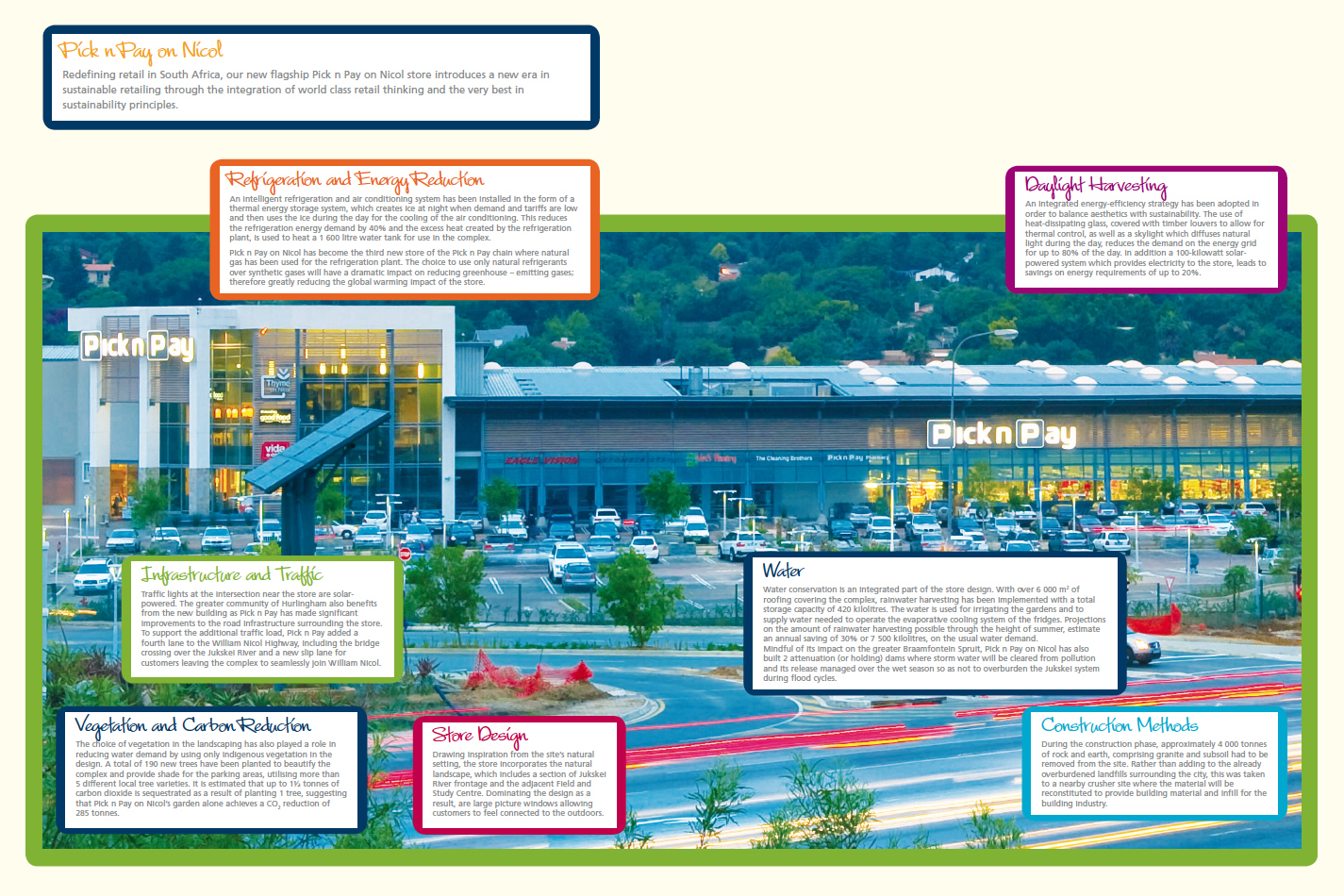
We constantly make our staff aware of the need to conserve energy usage and have instituted various energy saving initiatives such as the use of natural refrigerants over synthetic substances to reduce greenhouse emitting gasses. We have also recently built a green store being Pick n Pay on Nicol and are looking to implement certain features in selected stores. |
| Energy security and utilities pricing |
|
We are aware of the need to reduce usage of both electricity and fuel in the light of recent price increases and are constantly looking for ways to improve the consumption thereof. In the next financial year we will be installing new refrigeration technology that will significantly reduce energy usage from one of our largest energy consumers, refrigeration. |
Code of conduct
The Group has endorsed a comprehensive code of conduct founded on the highest levels of honesty, integrity and respect. All employees are expected to comply with the code at all times. The Board confirms that systems and procedures have been implemented to entrench the values and ethics laid down in the code of conduct, and to monitor compliance with the code.
All new staff members receive training on the code of conduct at induction. These values are continuously instilled through ongoing communication and training. A function of Human Resources is to monitor compliance with the code across the Group, to follow up complaints, to review disciplinary measures and the outcomes thereof, and to ensure the consistent application of disciplinary measures.
Further information on our code is available through our website.
Dealing in Group company shares
All dealings in Pick n Pay Holdings Limited and Pick n Pay Stores Limited shares by both Company and subsidiary company directors (where required by the JSE) and the Company Secretary are reported on the JSE Limited Securities Exchange News Service (SENS) within 48 hours of the trade having been made. Before these trades are entered into they must be pre-approved by duly authorised directors of the company concerned.
In addition to the above JSE regulated approval process, all sales of Pick n Pay Group shares must be approved internally as follows:
- The Chairman, by the lead non-executive director.
- The CEO and other directors of the Board, by the Chairman.
- Group Executive members, by the Chairman and the CEO.
- Other senior executives, by the CEO and Head of Human Resources, respectively.
All employees and Group entities are not permitted to trade in the Group’s shares during “closed periods” which start at the end of the last day of each financial reporting period and end with the publication of the respective result on SENS.
Party political support
While it is our policy to support social initiatives across party lines, we do not support any individual political party, financially or otherwise.
Directors’ attendance at meetings
Board meetings
| |
|
AGM |
|
|
|
| Director |
20 April 2010 |
18 June 2010 |
18 June 2010 |
19 Oct 2010 |
21 Feb 2011 |
GM Ackerman
(Chairman from 1 March 2010) |
P |
P |
P |
P |
P |
| NP Badminton (CEO) |
P |
P |
P |
P |
P |
| DG Cope (CFO) (retired 28 April 2011) |
P |
P |
P |
P |
P |
| SD Ackerman-Berman (appointed 1 March 2010) |
P |
P |
P |
P |
P |
| JG Ackerman (appointed 1 March 2010) |
P |
P |
P |
P |
P |
| HS Herman |
P |
P |
P |
P |
P |
| C Nkosi (retired 31 Dec 2010) |
P |
P |
P |
P |
— |
| D Robins |
P |
A |
A |
P |
P |
| BJ van der Ross |
P |
P |
P |
P |
P |
| RSJ van Rensburg |
P |
P |
P |
P |
P |
| J van Rooyen |
P |
P |
P |
P |
P |
| AM Mathole (Appointed 1 Nov 2010) |
— |
— |
— |
— |
A |
| LWC Phalatse (Appointed 1 Nov 2010) |
— |
— |
— |
— |
P |
| P = Present A = Apology |
|
|
|
|
|
|