Pick n Pay Stores Limited
CORPORATE GOVERNANCE REPORT
This report applies to Pick n Pay Stores Limited (Stores, alternatively the Company) and, where applicable, to Pick n Pay Holdings Limited RF (Holdings).
The Board takes overall responsibility for the performance of the Group, ensuring that the Group is managed in a transparent, equitable and responsible manner. Members of the Board operate as a resource for executives in the implementation of strategy and policy.
The Board and the Group are committed to upholding the highest standards of ethics, transparency and good governance, while pursuing sustainable and profitable growth. The Board is ultimately accountable for the ethical leadership, sustainability and good corporate citizenship of the Group, and is assisted in this regard by senior management. The Group’s commitment to good corporate governance is woven through every aspect of the management structure.
With the aim of achieving a balanced economic, social and environmental performance, the Board supports efforts to ensure the long-term sustainability of the business. Legitimate stakeholder involvement is kept in mind at all times and the Board fully supports the materiality approach, which emphasises integrated reporting based on issues and elements that can have a material impact on the sustainable performance of the business over the short, medium and long term.
The Board is supported by the audit and risk, corporate finance, corporate governance, nominations, remuneration and social and ethics committees to carry out its oversight role of ensuring that the activities of the Group are managed in a manner that is consistent with the values of the Group. These committees report to the Board on their activities in line with their delegated powers and authority, as set out in the corporate governance charter.
The Board believes that the Group has applied all significant governance principles and is compliant with all Listings Requirements of the JSE. The Group has not breached any regulatory requirements and has complied with statutory obligations. A full review of the application to the King III Code is available on our website at www.picknpayinvestor.co.za. The principles and recommendations of King III that are applied differently by the Board are set out below, along with explanations. The governance result on the governance assessment instrument (GAI) scale remains AA, as a result of our ownership structure, AAA being the highest measure. GAI is an independent measurement instrument of corporate governance best practice, endorsed by the Institute of Directors Southern Africa.
The Group has made progress in identifying and managing significant risks that could have a material impact on the business. Key risk metrics and measures have been developed with risk indicators clearly defined.
Summary of the application of King III principles
The table below explains King III’s recommendations that are differently applied by the Group.
|
Chapter and principle |
Comments for 2015 |
||
|
Chapter 2 – Board and directors |
|||
|
Principle 2.16 The Board should elect a Chairman of the Board who is an independent non-executive director. |
King III acknowledges that there may be sound reasons for a company to appoint a chairman who does not meet all the criteria for independence, but requires such a company to justify this decision and to put further checks in place to ensure no real or perceived conflicts of interest arise. Chairman Gareth Ackerman is not independent by virtue of his indirect shareholding in the Group. Refer to the Pick n Pay Stores Limited remuneration report and the Pick n Pay Holdings Limited RF remuneration report. Perceptions of conflicts of interest may arise regarding his decisions relating to the Group and its shareholders. Hugh Herman has been appointed as Lead Independent Director (LID). The main function of the LID is to provide leadership and advice to the Board when the Chairman has a conflict of interest, without detracting from the authority of the Chairman. The LID provides an important point of contact for the broader investment and stakeholder community should they have concerns with the running of the Company or potential conflicts of interest. All members of the Board have unfettered access to the LID when required. In addition to the role of the LID, and to ensure good governance, the chairmanship of four of the six Board committees is held by other independent directors. Consistent with the King III guidelines, Gareth Ackerman:
|
||
|
Principle 2.22 The evaluation of the Board, its committees and the individual directors should be performed every year. |
It had been anticipated that an external assessment of the Board would be conducted during the 2015 financial year. However, the Board unanimously resolved that such assessment was unnecessary, given the comprehensive internal assessment that is conducted annually. Individual performance evaluations of directors as well as of the effectiveness of the Board are undertaken annually by the Chairman of the Board. The evaluation of the effectiveness of the Board’s committees is undertaken regularly, but not necessarily annually. The results allow the Board to determine whether or not it has delivered on its mandate. It also measures, and where possible, enhances, the Board’s overall efficiency and each director’s individual contribution to the Board. If improvements are indicated, the necessary measures are implemented. |
||
|
Chapter 3 – Audit committees |
|||
|
Principle 3.5 The audit committee should ensure that a combined assurance model is applied to provide a co-ordinated approach to all assurance activities. |
The Board and audit and risk committee continue to develop and implement a comprehensive combined assurance approach to ensure the integrity of the financial and non-financial data contained within the report. |
||
|
Chapter 9 – Integrated reporting and disclosure |
|||
|
Principle 9.3 Sustainability reporting and disclosures should be independently assured. |
The Board and audit and risk committee continue to develop and implement a comprehensive combined assurance approach to ensure the integrity of the financial and non-financial data contained within the report. |
||
Board governance
Board composition
The Board consists of 14 directors. Of the nine non-executive directors, six are independent. As the Chairman is not independent, Hugh Herman has been appointed as LID (see note to King III principle 2.16). The remaining five directors are executive. Full curricula vitae of all directors are set out here.
The non-executive directors are diverse in their academic qualifications and business experience, resulting in a balanced Board, with directors who exercise leadership, enterprise, integrity and judgement in directing the business of the Group, so that it can thrive.
Board function
Directors are encouraged to promote rigorous debate with the aim of promoting active direction, governance and effective control of the Group. Decisions are usually made by consensus. All Board members, including those who are not independent, are well aware of corporate governance requirements, and are conscious of their obligation to act with integrity as representatives of all stakeholders in the Group.
The Board process is managed by the Company Secretary supported by the risk, legal, compliance and governance functions. The Board meets on a quarterly basis in line with the financial and strategic processes of the Group. The Board engages on a quarterly basis with management to examine progress made in the implementation of the Group’s strategic objectives.
Controlling shareholder representation on the Board
As representatives of the controlling shareholder, Gareth Ackerman, Suzanne Ackerman-Berman, Jonathan Ackerman and David Robins were nominated and elected by shareholders to the Board. Between them they have 64 years’ executive experience in the Group. Suzanne Ackerman-Berman and Jonathan Ackerman are executive directors, while David Robins was an executive director for 14 years and has been a non-executive director since 2008. The Chairman, Gareth Ackerman, has been with the Group for 31 years, the last 16 years (other than an 11-month period during the 2013 financial year) in a non-executive capacity. Their experience, as well as their strategic overview, assists the Group in making long-term decisions for the benefit of all stakeholders in the Group.
Executive representation on the Board
The executive function of the Group is performed by the executive committee, comprising Richard Brasher (CEO), Richard van Rensburg (deputy CEO) and Bakar Jakoet (CFO), all of whom are executive directors on the Board.
Annual assessment of independence
The Board corporate governance charter requires that an annual assessment of the independence of long-serving directors be performed by considering the following:
- The directors’ involvement with other companies;
- External directorships;
- Relationships with material suppliers and rival companies; and
- Material contracts with the Group, if any
The annual internal assessment of the Board was conducted. An internal assessment of the independence of non-executive directors was undertaken by the Chairman, who conducted individual interviews. Findings were presented to each non-executive director for them to either confirm, or to revert with further evidence supporting their independence. If required, the Company Secretary would solicit external legal opinion regarding the status of a non-executive director. Following this assessment, the Chairman made a recommendation to the Board as to independence. The Board interrogated the recommendations before a final decision was made.
All directors submit a list of their directorships and commercial interests to the Company Secretary, which are regularly updated, and distributed quarterly to the Board. Transparency of commercial interests ensures that directors can be seen to be free from any business or other relationship that may interfere materially with any director’s capacity to act in an independent manner.
Length of service
The Board has found that length of service does not automatically preclude a director from exercising independence in decision-making. It is our experience that our long-serving, non-executive directors are aware of, and vigorously exercise, their duty to act in the best interests of all the stakeholders of the Group. The Group values the balance achieved between the fresh insights from new directors and the experience of the long-serving directors.
Conclusion as to independence
At the time of the last assessment, all Pick n Pay’s independent non-executive directors met the criteria for independence as established by King III, the Companies Act and the JSE Listings Requirements. The Chairman and the Board are satisfied that, although Hugh Herman and Ben van der Ross have long-running relationships with the Group, their contributions remain unbiased, objective and vigorous.
In order to ensure that shareholder perceptions are aligned with the Board’s view of the independence of long-serving directors, all non-executive directors who have served on the Board for more than nine years serve one-year terms of office, instead of the standard three-year term. At the end of each term, the director and the Chairman jointly evaluate the director’s contribution and independence. By mutual consent the director may be considered for re-election. If so agreed, such director will be put forward for election by shareholders at the Company ’s annual general meeting for a further period of one year.
Ben van der Ross has advised the Chairman that he will not be available to stand for re-election at the 2015 AGM. The Chairman, on behalf of the Board, extended his thanks and gratitude to Ben van der Ross for the great contribution he has made to the Group since his appointment in 2000.
Board committees
The Board committees report back to the Board on how they carried out their responsibilities. The corporate governance charter governing the committees is assessed annually to ensure that the mandates remain current and effective. Our full corporate governance charter is available on the investor relations section of our website, www.picknpayinvestor.co.za. Each committee reviews its effectiveness by way of a review of their activities against the approved terms of reference. The chairman of each committee reports back to the Board on the assessment.
Company Secretary
The Board is aware of the duties the Company Secretary is required to perform and has created an environment in which the Company Secretary is able to ensure full adherence to Board procedures and relevant regulations. The Company Secretary is not a director of the Company , and the directors have unlimited access to the advice and services of the Company Secretary.
Annual consideration is given by the Board to the competence, qualifications and experience of the Company Secretary. The Board is satisfied that the Company Secretary meets the necessary requirements. The Company Secretary’s qualifications are outlined here. The Board is satisfied that the Company Secretary has maintained an arm’s-length relationship with the Board. The Company Secretary acts as secretary for all Board committees other than the remuneration committee, where the CFO acts as secretary.
Operational governance
There are well-entrenched governance structures within the Group to ensure proper assurance is given to strategic and operational matters, including:
- Property committee to manage real estate development
- Capital committee to manage capital expenditure
- Treasury committee to manage the debt structures and cash flow
The CEO is mandated to ensure that the day-to-day business affairs of the Group are appropriately managed by the group executive committee and that the necessary systems and controls are in place for the effective risk management of the Group.
The Board recognises that risk management is an integral part of the Group strategy and delegates to management the responsibility of designing, implementing and monitoring the risk management plan. The Group combined assurance model is interrogated by the audit and risk committee, and is tabled bi-annually to ensure that the Board is comfortable with the level and type of assurance that the Group obtains.
Compliance with statutory, legislative and regulatory requirements is managed through an integrated compliance framework. The compliance monitoring plan is approved on an annual basis. The plan provides independent objective assurance that material legislation applicable to the business has been monitored and ensures that processes and compliance controls are in place to manage compliance risk.
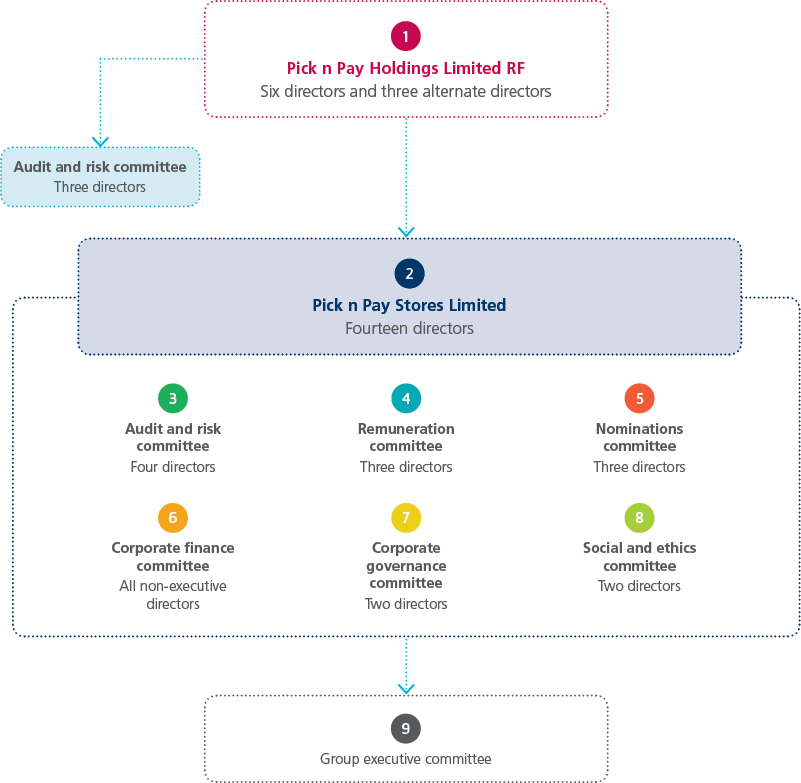
board Governance structure
The Board governs decision-making and gives leadership through its committee structure. The committees operate within Board mandates, ensuring that strategy is implemented through the operations of the Group. Progress is reported to the Board.
The diagram below is a summary of the current Board governance structure in the Group:
|
|
|
|
 Refer to the Pick n Pay Holdings Limited RF
  Refer to the Pick n Pay Stores Limited
  Refer to the
  Refer to the
  Refer to the
  Refer to the
  Refer to the
  Refer to the
  The Group executive committee comprises Richard Brasher, Richard van Rensburg and Bakar Jakoet.
Directors’ attendance at Board meetings
The Board convenes a minimum of four times per year for formal meetings, with additional meetings scheduled when necessary. The table below details each director’s Board meeting attendance during the past financial period:
|
Director |
Board and AGM attendance |
Activities 2015 |
||||
|
Gareth Ackerman (Chairman) |
5/5 |
|
||||
|
Richard Brasher (CEO) |
5/5 |
|||||
|
Richard van Rensburg (deputy CEO) |
5/5 |
|||||
|
Bakar Jakoet (CFO) |
5/5 |
|||||
|
Suzanne Ackerman-Berman |
5/5 |
|||||
|
Jonathan Ackerman |
5/5 |
|||||
|
Hugh Herman (LID) |
5/5 |
|||||
|
Ben van der Ross |
5/5 |
|||||
|
Jeff van Rooyen |
5/5 |
|||||
|
Lorato Phalatse |
5/5 |
|||||
|
David Robins |
5/5 |
|||||
|
John Gildersleeve |
5/5 |
|||||
|
Audrey Mothupi |
5/5 |
|||||
|
David Friedland |
5/5 |
|||||
Board committees
The role and responsibility of each Board committee is set out in the corporate governance charter, which is reviewed on an annual basis and approved by the Board. The full terms of reference of each committee can be found on our website at www.picknpayinvestor.co.za.
In line with the delegated powers and authorities, the committees report quarterly to the Board on how they carried out their responsibilities. All committees reviewed their responsibilities and are satisfied that they have carried these out during the year.