our environmental impact
Pick n Pay has been working for many years to minimise its environmental impact and to foster sustainable behaviour throughout its value chain. Reducing our consumption of environmental capital helps us to better manage our risks and reduce our costs. Environmental best practice is also a growing concern for our customers with more and more shoppers preferring to buy ethically and sustainably sourced products.

The areas in which we can make the biggest environmental difference are:
- improving energy efficiency and reducing our carbon footprint;
- tackling waste by minimising the amount we produce and recycling more; and
- embedding sustainability in our supply chain
We have identified and refined our key environmental impacts and formulated a clear strategy on climate change and food security. We have improved our environmental data management, which equips us to better execute our environmental reporting obligations.
We are pleased that our climate change strategy has been recognised both locally, through our inclusion in the Socially Responsible Investment Index of the JSE, and internationally through our inclusion in the Dow Jones Sustainability Index. In 2014 we achieved one of the leading retailer scores in the world, scoring 98A in the Carbon Disclosure Project, and were the only South African retailer to be included in both the Carbon Disclosure Leadership Index (CDLI) and Carbon Disclosure Performance Leadership Index (CPLI).
Doing more with less
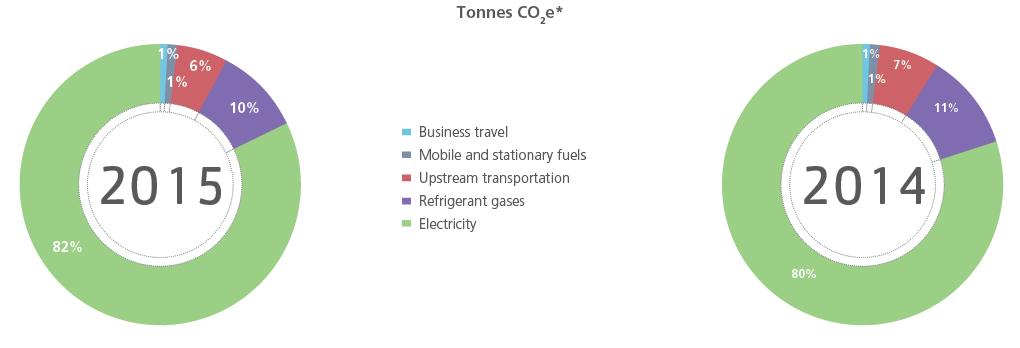
Electricity usage accounts for 82% of our total carbon footprint. Our energy reduction strategy focuses on our stores, which consume over 90% of the electricity we use. Key elements of this strategy are implementing innovative technologies in new stores and retrofitting existing stores’ refrigeration, lighting and air-conditioning. Since 2012, we invested R76 million in various energy efficiency projects.
New stores opened in the past year are up to 44% more energy efficient than stores opened in 2010. Since 2008 we have reduced our electricity intensity by 32%, saving our business, in total, R749 million and 840 million kWh of electricity. This year Pick n Pay’s carbon intensity reduced by 0.9% against a 2013 baseline.
We have set the following targets to be achieved by 2020:
- Carbon emissions’ intensity to reduce by 15%, measured against a 2013 baseline
- Absolute emissions to reduce by 5%, measured against a 2013 baseline
- Achieve overall energy efficiency improvements of 40%, measured against 2008 baseline
We are unlikely to achieve our target of zero waste to landfill by 2016. The greatest challenge we face is the lack of access to cost-effective solutions for treating organic waste in South Africa. We have however, succeeded in reducing the amount of waste we send to landfill by recycling 45% of Pick n Pay-owned store waste and donating 933 tonnes of surplus food to charity.
This year we are developing a partnership with AgriProtein which will explore the recycling of organic waste by fly larvae into protein for farmed animals.
We provide a nationwide network of collection points for consumers wanting to recycle light bulbs, batteries, plastic bags and ink cartridges, and we continue to introduce enterprising recycling initiatives, many of which create job opportunities.
Our direct water footprint is limited. Our 10 distribution centres account for 12% of our water footprint and have been the focus of recent water efficiency efforts. In 2015 we consumed an estimated 1 316 megalitres of water at stores (2014: 1 133 megalitres) with a water intensity of 1.11 kl/m2 (2014: 1.19 kl/m2 ).
In the year reviewed we recorded a number of environmental achievements related to our supply chain and products. These included:
- Sales of free range products grew by 8.3% to R55.9 million
- The quality of the PnP Green range of products was further improved and rebranded. PnP Green range products are vegan and approved by the Beauty Without Cruelty Association
- We sold 16% more wine (with a retail value of R82.0 million) certified by the Biodiversity and Wine Initiative, a multi-stakeholder project to produce wines that have a minimal impact on the fragile Cape Floral Kingdom
- Since 2010 we have invested R13.5 million in the World Wildlife Fund’s Sustainable Fisheries Programme. (By year-end 45% of our seafood products by species, and 87% of these products by sales, met our seafood sustainability targets)
- Sixty-five percent of our fresh produce suppliers (133 out of 204 suppliers) were Global GAP (Good Agricultural Practices) certified
- We reduced the salt content in 113 of our products and are in the process of reducing salt levels in 127 more
- We conducted more than 2 000 supplier audits and 5 700 product tests on Pick n Pay branded product suppliers, to ensure that Pick n Pay branded products meet or exceed health and safety standards and legislative requirements
Our carbon footprint
For more on our social value creation, see our 2015 Sustainable Living Report on our website, www.picknpay.co.za
Information contained in this report relates to Pick n Pay-owned stores only.