
GROUP GOVERNANCE
Pick n Pay Stores Limited
Remuneration committee report
Introduction
This report is divided into two sections:
Section one – describes the Group’s remuneration policy for directors and key executives, illustrates how remuneration is structured to ensure alignment with Group strategy and the interests of shareholders, and details the role and composition of the remuneration committee.
Section two – discloses the actual payments, accruals and awards for the 2014 financial year.
This report and the recommendations of the remuneration committee have been approved by the Board and will be submitted to shareholders for consideration at the annual general meeting (AGM) to be held on 2 June 2014.
Section one
Remuneration policy
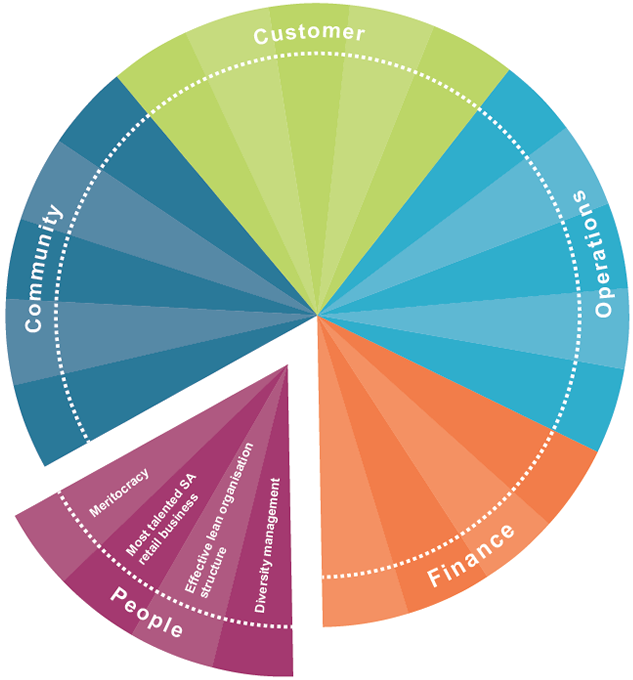
The balanced scorecard above illustrates the core objectives of our long-term business strategy, which is balanced across our five key focus areas. Our people are an integral part of Pick n Pay’s long-term strategy to become the retailer for every South African.
Our Group remuneration policy supports the objectives of our long-term strategy:- Meritocracy – people will be recognised and advanced based on merit
- Most talented SA retail business – we will attract, retain and develop the most talented retail staff in the industry
- Effective lean organisation structure – we will create and reward a culture of productivity and efficiency
- Diversity management – we will ensure Pick n Pay offers equal opportunities to people from all walks of life
The Group’s remuneration policy is aimed at attracting, retaining and motivating employees and executives, while aligning their remuneration with shareholder interests and best practice. We reward employees for their individual contribution to the Group’s strategic, operating and financial performance. We ensure that our remuneration policy supports the development and retention of top talent, while attracting critical skill and experience in the retail industry.
The remuneration policy is supported by the following underlying principles:- Remuneration at all levels is benchmarked against our peers (both locally and internationally) to ensure that it is fair and just
- An independent expert assists the remuneration committee with benchmarking
- Employees and executives are rewarded for meeting key performance targets
- Remuneration levels for executive directors take into account remuneration policies and practices of comparable companies
- Executive remuneration is balanced between long-term and short-term incentives
- Non-executive directors do not receive remuneration or incentive awards related to share price or corporate performance
We believe that the remuneration policy is aligned with the long-term strategic objectives of the Group and will contribute to long-term, sustainable value creation in the business.
Remuneration committee
The remuneration committee assists the Board in meeting its responsibility for setting and administering appropriate remuneration policies which are in the best long-term interests of the Group and are aligned with the Group’s long-term strategic goals. The committee considers and recommends remuneration policies for all levels of staff in the Group, with a particular focus on executive directors, senior management and non-executive directors.
The remuneration committee meets at least twice a year, is chaired by an independent non-executive director and comprises only non-executive directors. The committee operates in terms of a Board-approved charter (available on our website at www.picknpayinvestor.co.za). Its charter is reviewed annually at the Board meeting in April. The committee’s key responsibilities are to:- review the Group’s remuneration philosophy and policies to ensure alignment with the objectives of the Group
- review the Group’s remuneration philosophy and policies to ensure alignment with best practice in the market
- determine the remuneration packages of executive directors and to review the remuneration packages of senior management and key employees
- propose fees for non-executive directors, subject to shareholder approval
- approve performance-related short-term incentives as well as long-term share-based incentives
| Director | Status | 8 April 2013 |
24 July 2013 |
17 October 2013 |
28 January 2014 |
| Hugh Herman (Chairman) | Independent non-executive | p | p | p | p |
| Gareth Ackerman | Non-executive | p | p | p | p |
| Ben van der Ross | Independent non-executive | p | a | p | p |
| P = present A = apology |
Remuneration activities and decisions made during the 2014 annual financial period
The main items considered and approved by the remuneration committee during the 2014 annual financial period were as follows:- Executive and non-executive director remuneration benchmarking, including a review of all benefits provided
- Reviewing and setting the annual compensation for the CEO
- Annual salary increases for executives
- Determining an appropriate bonus for executives and the reasonable allocation thereof
- Approving all share option allocations to executives
- Reviewing of the Group’s short-term incentive scheme and the introduction of a new forfeitable share plan for key executives (for further information refer to here)
- Reviewing and approving of the Group’s remuneration policy and report
- Reviewing and recommending to the Board the overall compensation for the Chairman, for final approval by shareholders at the AGM
- Reviewing and recommending non-executive directors’ fees for the 2015 annual financial period, for final approval by shareholders at the AGM
Risk management and remuneration practices
The remuneration committee ensures that corporate governance and legal requirements are met when existing remuneration policies are reviewed and new remuneration plans and policies are put in place. In doing so the committee ensures that shareholder interests are protected, and reward systems, remuneration policies and targets are aligned with the Group’s risk tolerance.
Executive directors and senior management
Remuneration structureThe Group balances remuneration across three broad categories to ensure:
- employees are fairly rewarded for performance
- employees are incentivised to meet short-term and long-term strategic goals (which are balanced between fair and achievable, and ambitious)
- employees are rewarded for initiative and innovation
- employees are encouraged to grow and stay with the Group over the long term
